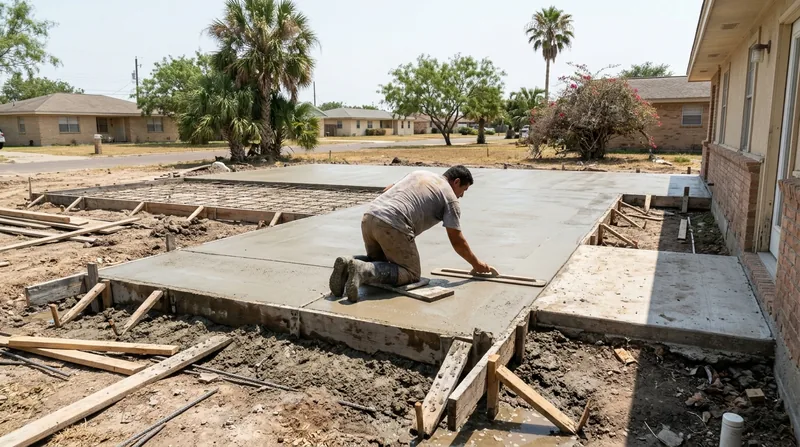




Concrete Slabs & Foundations in Brownsville are the backbone of every structure in the Rio Grande Valley, from the historic brick cottages of downtown to the modern subdivisions spreading north and west. The flat delta terrain, expansive clay soil, and seasonal flooding rains make proper slab design and installation critical to long-term stability. Brownsville's hot, humid climate and salt-air exposure near the coast accelerate concrete aging and demand reinforcement strategies that account for soil movement and moisture. We pour engineered slabs with proper base preparation, steel reinforcement, and joint design to prevent the cracking, heaving, and settling that plague so many older homes in this region. Whether you need a foundation for a garage, room addition, shed, or new construction, we build slabs that stand up to decades of Rio Grande Valley weather.
Why Concrete Slabs & Foundations Matter in Brownsville's Unique Soil and Climate
Brownsville sits on the Rio Grande delta, where heavy silty clay and expansive soils shift with every wet and dry cycle. Long, hot summers with 90-plus degree temperatures, sudden tropical downpours, and hurricane-season flooding create constant stress on concrete. The shallow water table near the resacas, combined with salt air closer to Port Isabel and South Padre Island, accelerates deterioration if the slab is not properly sealed and reinforced. A poorly installed foundation will crack, heave, or settle within a few years, compromising structures and driveways alike. We engineer every slab to handle Brownsville's specific soil behavior and weather patterns.
- We compact and test the base layer to ensure uniform support and prevent future settling.
- We install steel reinforcement (rebar or wire mesh) to resist the tensile stress from soil movement.
- We design control joints to direct cracking away from high-traffic and high-stress areas.
- We specify concrete thickness and mix design that resist salt air and moisture penetration in the Valley.
- We grade and slope the slab for proper drainage, keeping water away from the foundation perimeter.
These practices keep your slab stable and crack-free for 30 years or more, even as the clay beneath it swells and shrinks.
Key info: Brownsville's expansive clay soils swell up to 8 percent when wet and shrink dramatically in dry spells. Without proper reinforcement and base preparation, concrete slabs crack within 2 to 3 years. We design for this reality.
For more on how soil conditions affect concrete durability, the USDA Natural Resources Conservation Service publishes soil surveys for Cameron County that detail the clay and silt composition of the Brownsville area.
How We Build Concrete Slabs & Foundations in Brownsville: Our Process
Every slab we pour in Brownsville follows a systematic approach designed for the Valley's soil and climate. We start with a site assessment to understand drainage patterns, soil type, and load requirements. Then we prepare the base, install reinforcement, set forms, pour concrete to specification, finish the surface, and cure it properly. The entire process takes careful attention to timing, especially in summer heat when concrete sets faster. We work year-round in Brownsville, but we adjust our schedules to avoid the hottest afternoon hours when possible.
- We excavate and grade the site to slope away from structures, ensuring water does not pool on or under the slab.
- We install and compact a 4 to 6 inch base layer of crushed stone or recycled asphalt to provide uniform support.
- We place steel reinforcement (rebar grid or wire mesh) at mid-depth to resist tensile stress from soil movement.
- We set and secure concrete forms to the correct height and slope.
- We pour concrete to the specified thickness, typically 4 to 6 inches for residential slabs and foundations.
- We finish the surface (smooth, broom-finish, or textured) and cut control joints at 4 to 6 foot intervals.
- We mist-cure the slab for 7 days to allow the concrete to gain strength and resist cracking.
This disciplined process, applied to every job from a small shed pad in Olmito to a major room addition in Rancho Viejo, ensures that your concrete performs for decades.
Local example: A homeowner in the Southmost neighborhood needed a new foundation for a 20 by 24 foot garage. The existing soil was compacted clay with high salt content near the surface. We removed 8 inches of topsoil, installed a 5 inch compacted base, placed a full rebar grid, and poured a 5 inch slab with a broom finish. We sloped it 1 percent away from the structure and cut joints every 5 feet. The slab has remained flat and crack-free for over four years despite two major tropical storms.
For engineered design details and load calculations, see our Garage Floors service page for examples of how we handle foundation loads in residential garages.
Concrete Slab & Foundation Installation Methods and Approaches
| Approach | Description | Best for |
|---|---|---|
| Slab-on-Grade with Rebar Grid | Concrete poured directly on a compacted base with steel reinforcement at mid-depth, control joints cut every 4 to 6 feet, finished smooth or broom. | Garages, sheds, carports, room additions, and new construction on stable, well-drained soil. |
| Thickened-Edge Slab (Monolithic) | A single continuous pour where the perimeter is thickened (typically 8 to 10 inches) to act as a frost-free footing, while the interior remains 4 to 6 inches. | Residential foundations and structures where a single pour reduces joints and labor. Common in Brownsville for new construction. |
| Post-Tensioned Slab | High-strength steel cables are placed within the slab before pour, then tensioned after curing to counteract soil movement and reduce cracking. | Large additions, commercial slabs, or highly expansive soil where standard reinforcement alone is insufficient. |
| Pier-and-Beam Foundation | Concrete piers driven or set into stable soil below the active clay layer, with a beam or slab supported above, creating a gap for drainage and ventilation. | Flood-prone areas, structures near resacas, or where soil subsidence is a concern and elevation is needed. |
Concrete Slabs & Foundations Cost in Brownsville: What to Expect
Pricing for concrete slabs and foundations in Brownsville typically starts at around $5 per square foot for a standard slab-on-grade with basic reinforcement and finishing. A 20 by 24 foot garage foundation (480 square feet) would run roughly $2,400 to $3,200 before site prep, permitting, or special conditions. The final cost depends on several factors specific to your location and soil conditions. Expansive clay soil, poor drainage, proximity to trees or structures, and the need for thickened edges or post-tensioning will increase the price. Getting 2 to 3 estimates from insured contractors allows you to compare approaches and understand what each bid includes.
Our full pricing overview breaks down costs by slab type, size, and finish. For a free, no-obligation estimate tailored to your site, call us at (956) 431-0098 or request an estimate online.
What to Look for When Hiring a Concrete Contractor Near Brownsville
Choosing the right contractor for your slab or foundation is as important as the concrete itself. Look for a company that carries full general liability insurance and workers' compensation coverage on every job. Ask for a certificate of insurance before work begins, and verify that the policy is current and covers the scope of your project. Get at least two or three written estimates so you can compare pricing, materials, and methods. Check references from recent jobs in Brownsville and the surrounding Valley communities like Harlingen, San Benito, and Port Isabel. Understand local permitting requirements, especially for driveways and sidewalks that may require municipal approval or curb-cut permits. If your property is in an HOA, confirm that your slab design meets community guidelines before we begin.
When you're ready to move forward, contact us for a free estimate. We'll assess your site, explain our approach, and provide a detailed proposal with no obligation.
Concrete Slabs & Foundations in Brownsville: Pricing Guide
| Service | Price | Details |
|---|---|---|
| Standard Slab-on-Grade (4 to 6 inches) | From $5/sq ft | Includes base prep, rebar reinforcement, concrete pour, finish, and control joints for residential garages and additions |
| Thickened-Edge Monolithic Foundation | From $6.50/sq ft | Thickened perimeter (8 to 10 inches) plus interior slab in single pour, ideal for new construction in Brownsville |
| Post-Tensioned Slab (Expansive Soil) | From $8/sq ft | High-strength cables tensioned after curing to resist Rio Grande Valley clay movement and reduce cracking long-term |
| Complex or Large-Scale Job | On estimate | Site-specific conditions such as poor drainage, proximity to resacas, or structural loads require on-site assessment |
| Travel and Permitting | Included | No separate mileage fee in Brownsville and surrounding areas; permit coordination available at cost |
| Free Estimate | No charge | Response within 24 hours at (956) 431-0098; includes site assessment and written proposal with no obligation |
Indicative pricing, the exact cost depends on square footage, finish, and site access. Free personalized estimate within 24h at (956) 431-0098.


